


Dolly Parton died today, at 80 years of age, in Nashville, Tennessee, after a brief battle with cancer. Her nephew, Bryan Seaver, confirmed the news in a short social media post. Her team followed with a statement describing her as someone whose “wit, warmth, and kindness made us all feel like family,” adding she’d “forever stand as an inspiration” through her “timeless music and prolific songwriting.”
Parton spent nearly seven decades as a performer and songwriter, racking up dozens of top-10 country hits and writing standards like “Jolene” and “I Will Always Love You” that continue to transcend generations. She acted in 9 to 5, Steel Magnolias, and The Best Little Whorehouse in Texas, and wrote the “9 to 5” title song herself that earned an Academy Award nomination for Best Original Song. She built her theme park, Dollywood, into one of Tennessee’s biggest tourist draws. Her jokes about her own bombshell image never read as an act, and that combination made her one of the rare entertainers almost universally loved.
Even in NDN Country, Dolly Parton had a huge impact on our communities through her music, movies and philanthropy. However, her passing has also brought back a less flattering thread of coverage: criticism of a Native American segment in her Stampede dinner show that’s dogged the attraction for years.
The Imagination Library’s Native Partnership
Dolly Parton founded the Imagination Library in 1995, in honor of her father, who never learned to read. The program mails a free book every month to enrolled kids from birth to age 5, and it’s since spread well beyond Tennessee into Canada, the UK, Australia, and Ireland.
One of the program’s biggest expansions happened in December 2002, when organizers announced a push to bring the Imagination Library to preschoolers in 92 Native American communities across the country.
The U.S. Bureau of Indian Affairs signed on as an official sponsor that year, the program’s first-ever partnership with a federal agency. Ten United Way chapters, led by the Sioux Empire United Way, coordinated a statewide effort to reach Native children in South Dakota. Georgia’s Ferst Books Foundation started distributing books in eight Native communities with plans to go statewide, and Tennessee built out its own parallel push at home.
By the end of 2002, the Imagination Library had expanded to 185 communities and was sending books each month to more than 30,000 children. Organizers credit much of that growth to the program’s outreach to tribal communities. Native organizations, including the First Nations Health Consortium, continue to connect Native families with the program. The expansion also offered an early example of a strategy that would help the Imagination Library grow internationally: make enrollment simple and work through local organizations that families already know and trust.
Redface Criticism at the Stampede
Parton’s business ventures haven’t always gotten the same easy approval. Her Pigeon Forge dinner-and-horse-show attraction, now known as Dolly Parton’s Stampede, originally opened as Dixie Stampede, featuring a staged rivalry between riders representing the North and South.
In 2018, the operators dropped “Dixie” from the name. A company spokesman told Fox News that the change was primarily to avoid confusion as the attraction expanded. The old name, he said, led people in new markets to assume the show wasn’t what he described as “a very patriotic, spectacular, horse show.”
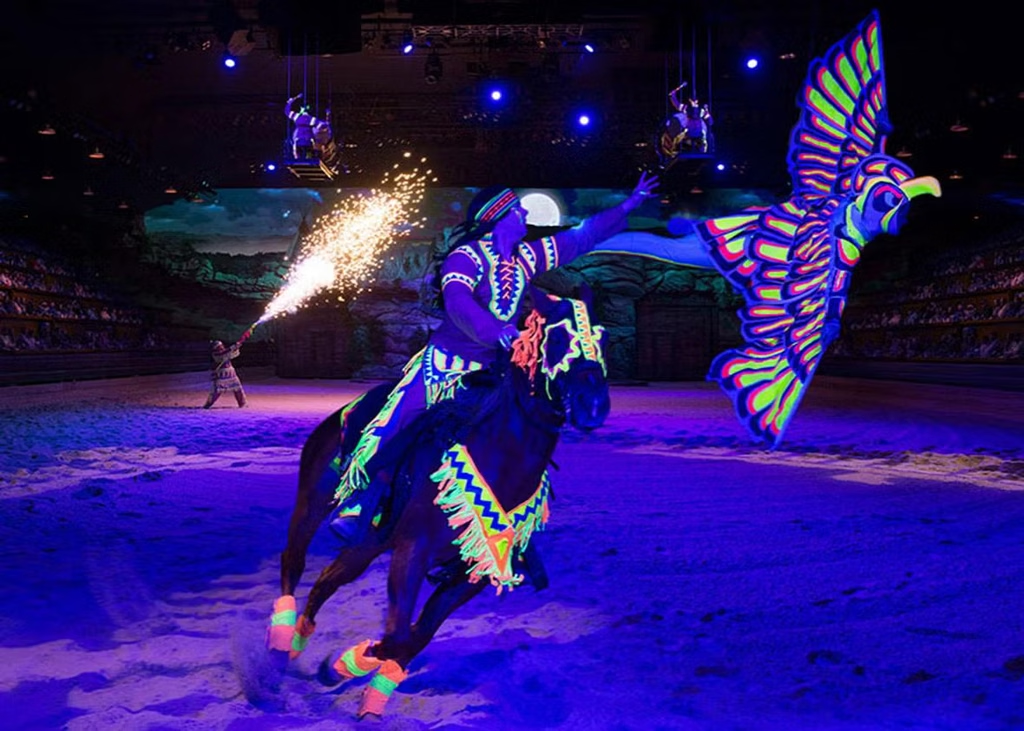
However, the show’s portrayal of Native people has drawn just as much criticism as the glorification of the Confederacy. One recurring segment features a non-Native performer suspended over the arena by cables while portraying a “Native American” character in what the show’s promotional material describes as a “Cherokee” dance “steeped in legend…mystery…and magic.” Clips of the performance have also circulated on TikTok, where users have criticized the show’s redface and cultural appropriation. Native people, for decades, have argued that the problem goes beyond the costume and performance itself because it’s portraying Natives as a reductive stereotype while simultaneously contributing to the erasure and whitewashing of American History.
The 2018 name change didn’t alter or even address that portion of the production. A Slate report by a visitor who saw the revised show found the Native American segment still in place after the Confederate references were removed. The writer noted that the show’s “valorization of Western colonization and awkward representation of Native Americans remains.”

Somewhere between the 2018 Slate report and the present, the show’s Native-themed portion appears to have been phased out. The segment featuring the suspended “Native American” performer is no longer part of the production and has been replaced by a display of neon butterflies. The change removes one of the show’s most visibly criticized elements, although it’s unclear exactly when the transition happened or whether the decision was made in response to the criticism.
Parton herself has rarely addressed those criticisms at length. That’s broadly in line with what she’s said over the years about politics. She’s often described herself as an entertainer rather than a political commentator and has said she prefers to stay out of political fights. In a 2020 interview with NPR, she spoke about Black Lives Matter while also explaining her preference to focus on her work rather than get pulled into political arguments.
Two legacies, side by side
Dolly Parton’s legacy is just as multifaceted as she was as an entertainer and philanthropist. Her work has reached people around the world, including Native families who benefited from the Imagination Library’s partnerships with tribal organizations. But her association with and silence regarding The Stampede’s portrayal of Native people make for a harder chapter. The dinner show faced years of criticism over its portrayal of Native people, creating an uncomfortable contrast with Parton’s philanthropic work in Native communities.
But Parton has also shown a willingness to listen and learn from the people around her. Change didn’t always come on the timeline critics wanted or through a public statement. The Native-themed segment has been silently phased out of the Stampede and replaced with a segment featuring neon butterflies, without the kind of publicity campaign that accompanied the removal of “Dixie” and Confederate references. Given the backlash over those changes, a quieter approach may have avoided putting Native people at the center of another public fight.
The good Parton did, and the harm she was criticized for, can both be acknowledged without diminishing or negating each other. It’s not a contradiction to mourn the loss of Dolly.
NDN Country Mourns an Icon.
Mourning Dolly doesn’t mean Native people have forgotten or forgiven the harm done by the portrayal of Natives in Dolly Parton’s Stampede. It just means we can remember what she gave us, too. The songs our matriarchs loved and cleaned to, characters we loved, laughter we shared, and the woman who spent much of her life trying to make people feel welcome.
People are rarely remembered in only one way. Dolly’s story is no different. She gave the world an enormous body of music, spent decades giving back, learned from people around her, and left some difficult questions behind. Native people can hold all of those truths at once.
So, NDN Country mourns an icon. Not because Dolly was perfect, but because sometimes a person’s place in our memories has less to do with perfection than with how often they were simply there.
Dolly was there, and her legacy will continue to impact generations of Native children who receive books, just as our memories of what she meant to us and our matriarchs will still stay with us.
Discover more from Red Pop! News
Subscribe to get the latest posts sent to your email.


