


A long time ago, in a galaxy far, far away, George Lucas told a story NDN Country already knew. The empires, the occupations, the stolen children, the scattered survivors holding onto culture by any means necessary. Indigenerds didn’t need to search for themselves in the Star Wars universe. We were already there, written into the bones of its vast universe, before we even bought a ticket or picked up a stick for rez style light saber battles. And on May 22, 2026, we’re buying more tickets and leaving the sticks at home.
Because Mando and Grogu are coming to the big screen and Indigenerds across Turtle Island are already counting down the days.
The Mandalorian and Grogu picks up in the aftermath of the Empire’s fall, which sounds like a clean ending until you realize endings in this galaxy work the same way they work in ours. The evil Empire has fallen, but Imperial warlords are still scattered across the galaxy, still clinging to what they carved out when they had the full weight of institutional power behind them. The fledgling New Republic is doing the ongoing, exhausting work of protecting everything the Rebellion bled for, and they have enlisted the legendary Mandalorian bounty hunter Din Djarin and his young apprentice Grogu to help hold that line.

Just as the story is expanding in scale, so is the cast. Sigourney Weaver joins as Ward, a veteran pilot and leader within the New Republic’s Adelphi Rangers. Jeremy Allen White steps in as the voice of Rotta the Hutt. Jonny Coyne returns as an Imperial warlord still holding onto whatever scraps of power he can grab. Dave Filoni is back on screen as X-wing pilot Trapper Wolf, which means something if you have followed how deeply Filoni has shaped the lore of this universe across The Clone Wars, Rebels, and beyond. Garazeb “Zeb” Orrelios, voiced by Steve Blum, shows up alongside Embo from The Clone Wars and the Anzellans first introduced in The Rise of Skywalker.
A Long Time Ago, In a Galaxy Not So Different From Ours
Before we get into why NDN Country is excited for The Mandalorian and Grogu, we need to talk about why Star Wars resonates for Indigenous audiences, because the connection runs much deeper than one character or one show.
The Empire’s reach across the Star Wars galaxy follows a blueprint Native peoples recognized the moment we first saw it on screen. Extermination. Expulsion. Segregation. Assimilation. Integration. Each stage maps onto the histories our communities lived through and are still living through, and the stories within that universe make those parallels impossible to look away from once you see them.

The destruction of Alderaan illustrates the most extreme end of that blueprint, a peaceful planet wiped out because the Empire needed to demonstrate what resistance would cost everyone watching. The Sand Creek Massacre of 1864 operated on that same logic.
For years, the US government had been systematically pushing Cheyenne and Arapaho peoples off their lands through a series of treaties that kept shrinking their territory to make room for white settlers and gold rush prospectors moving through Colorado. By November 1864, a band of Cheyenne and Arapaho people led by Chief Black Kettle had camped at Sand Creek under the explicit assurance of US Army protection. However, on November 29, 1864, Colonel John Chivington and the Third Colorado Cavalry massacred over 200 Cheyenne and Arapaho people, the majority women, children, and elders, to send a message to other tribes and crush their resistance.
On Kashyyyk, the Wookiees were enslaved following the Empire’s occupation, after being reclassified as a slave species. Very similar to the encomienda system that was imposed across the Americas after Spanish colonization. It was a system that locked Indigenous peoples into forced labor on their own lands under the cover of legal frameworks designed to make that theft look justified and legal.
The Empire’s occupation of Jedha is something that Indigenous people relate to as well. The Empire didn’t just occupy Jedha; they destroyed a sacred site to mine kyber crystals to power the Death Star. The Black Hills of South Dakota offer a real-world parallel, Lakota sacred land invaded for gold despite the explicit protections of the Fort Laramie Treaty. But, Jedha also echoes Oak Flat in Arizona, where the San Carlos Apache have spent years fighting to stop a foreign mining company from blowing apart a site at the center of their ceremonies and identity.
Assimilation runs through the Star Wars franchise the way it runs through our histories. Remake a person from the inside, strip away language, sever the connection to their community and their history, and what you produce is someone who no longer has the cultural framework to imagine a different world or the communal bonds to fight for one.
The First Order took that template and ran it to its ugliest conclusion with Project Resurrection. They took children from their families and planets, replaced names with numbers, and trained children from infancy to serve a system that required them to relinquish and forget their inherent identities. In The Force Awakens, Finn was a prime example. He was FN-2187, trained from infancy to be a stormtrooper before he was able to escape and become Finn. The Jedi Order, while positioned as the good guys, actively looked to identify Force-sensitive children young, separating them from their families, and reshaping them within an institution that decided who and what they would become. We saw this play out in Episode One: The Phantom Menace with a young Anakin Skywalker taken from his mother to be trained as a Jedi.
The US government was also following the same template when it built the Carlisle Indian Boarding School and the 407 schools that followed. Children as young as four were taken from their families, given English names, forbidden from speaking their languages, and punished physically when they tried. The attachment to mothers, communities, ceremony, and land was not seen as something to be honored or even managed carefully, the way the Jedi Council debated with young Anakin. It was seen as a threat to be eliminated as efficiently as possible. Where the Jedi at least wrestled with the ethics of what they were asking a child to surrender, the US government never lost sleep over the violence of the Residential Indian Boarding School Era.
The racial hierarchy baked into the Empire’s governance is another thing Indigenous peoples recognize. Human-centric Imperial structure placed one group at the top and organized everything else beneath it, with the species and peoples who held the least power either pushed to the margins or marked for elimination. Colonial governments have done the same thing with European settlers at the top and Indigenous, Black, and other marginalized groups slotted somewhere between obstacle and resource.
Where Indigenous, Black, and other marginalized communities have always found themselves reflected in the Star Wars universe is in the Resistance. The Rebel Alliance was never a single species or a single culture. It was built from every corner of the galaxy because the Empire had pushed too far. Resistance movements have operated on that same understanding for centuries, building solidarity with other communities facing the same machinery of oppression. You fight what you have in common with whoever else is fighting it, and in both this galaxy and that one, there has never been a shortage of people with something in common worth fighting for.
But oppressive systems and regimes are never truly vanquished. Indigenous peoples know that better than anyone, and it’s what makes the Star Wars universe so compelling. The Empire doesn’t vanish when the Death Star goes down. The First Order rises directly from its infrastructure and ideology. It has reorganized and rebranded, but it’s still the same evil. It’s the same thing as how, for Indigenous peoples, the Doctrine of Discovery became Manifest Destiny, became federal Indian policy, became termination and relocation, became the modern legislative assaults on tribal sovereignty. Sacred site protections get reversed. Pipelines rejected under one administration get permitted under the next. The names and justifications change, but it’s still the same evil. Watching the First Order emerge from the Empire’s destruction is not a plot twist for Indigenous audiences. We’ve lived that sequel more times than we can count.
Mando Showed Us the Way and Grogu Stole Our Hearts
As a lifelong Star Wars fan, unapologetic Indigenerd, and founder of the late A Tribe Called Geek, I’ve spent years watching our communities search for and find themselves in stories and fandoms that weren’t created with us in mind. We managed to create our own spaces within these fandoms because while the stories weren’t created with us in mind, elements of the stories, from imagery to language, were influenced by our cultures. Aside from the parallels we see in our own histories, the Star Wars universe has been heavily influenced by Indigenous cultures worldwide. The fingerprints are everywhere, from Leia’s space bun to the Huttese language, from the Ewoks to the Mandalorians, which is why Natives have always gravitated toward the fandom. So, when The Mandalorian premiered in 2019, I knew that it was going to be more than just a pop cultural phenomenon within NDN country.
I wasn’t wrong.
The second that Din Djarin appeared on screen, Natives were hooked, and we didn’t need a backstory to know Mando was a man led by culture and tradition, born into a history of imperial violence. Holding on to his identity and culture as best he could after the Great Purge nearly erased the Mandalorian people, survivors forced underground or scattered to the far edges of the galaxy. Native peoples have lived that same struggle on our own lands, across generations. Seeing it rendered in a galaxy far, far away, through Mando’s refusal to give up his identity, values, and culture just served to remind us that “This is the way”.
Native artists were quick to start creating art inspired by Mando and the parallels that we saw to our own histories. Artist Christal Ratt (Algonquins of Barriere Lake) created wiigwas (birch bark) Mandalorian armor that went viral in 2022. The armor won 2nd place in the Diverse Art Forms category of the Heard Guild Museum’s 2022 Indian Market and Fair in Phoenix, Arizona. It later became part of The Return of the Force, an exhibit at Fort Lewis College’s Center of Southwest Studies featuring works by over twenty Indigenous artists, including Diné painter Ryan Singer and On’k Akimel O’odham artist Dwayne Manuel, to showcase and celebrate the influence of Star Wars on contemporary Native art. At the 2024 IndigipopX in Oklahoma City, Star Wars Cosplay was at its very best. While the Choctaw Padme took top honors, the Powwow Mandalorian was a prime example of how influential The Mandalorian has been in our communities. Mando gave our artists a figure worth reimagining, but as influential as Mando is, it was Grogu that really stole our hearts.
Within hours of the premiere, he was already ours. As Simon Moya-Smith (Oglala Lakota) pointed out in his 2019 article, The Mandalorian’ may never reveal Baby Yoda’s true origins. But Native Americans already know, every nation was ready to make their case, the Ho-Chunk, the Ojibwe, the Diné, the Choctaw, each tribe prepared to argue why Grogu belonged to them. Tara Houska (Couchiching First Nation) saw Grogu as a Native child at ceremony, quietly absorbing ancestral knowledge and tradition that stretches back thousands of years. Moya-Smith saw something equally familiar: the kid at every powwow and protest who hangs back and watches, not leading yet, but paying close attention to everything happening around him. Every Native community raises that child; we’ve all been that child. NDN Country recognized Grogu for what he was. A child learning the way, held and protected by his people while he grows into what and who he was always meant to be.

And underneath all of that was a heavier recognition. Grogu survived Order 66, a genocide that left him likely to be the last of his kind. He survives in a world that keeps sending enemies to either exploit or destroy his connection to the Force. The people who care for him, who keep him alive, are never institutions. They are individuals and communities making costly personal choices. We understand the reality of the risks they are taking to keep Grogu safe because we have taken and still take the same risks to protect our youth.
Like Grogu, Native children have faced similar dangers. Generations of Native children survived the Residential Indian Boarding School era because of the way that our communities risked everything to keep children hidden from Indian Agents, to bring them children home from the schools, and even now, we’re still fighting to bring those who didn’t survive home.
Native children have been removed from their communities, funneled into foster care, and adopted out to non-Native families. The Indian Child Welfare Act was passed in 1978 because Congress had documented for decades that Native children were being removed from their families at rates between 25 and 35 percent nationally. ICWA established the sovereign right of Tribal Nations to protect the best interests of Native children, maintain tribal stability, and reduce the rate of Native children removed from their homes and communities. Grogu’s story mirrors many of the reasons why that law had to be written.
It’s also why we were so quick to claim Grogu as one of our own and why Grogu has really dominated our hearts and Indigenous pop cultural landscape.
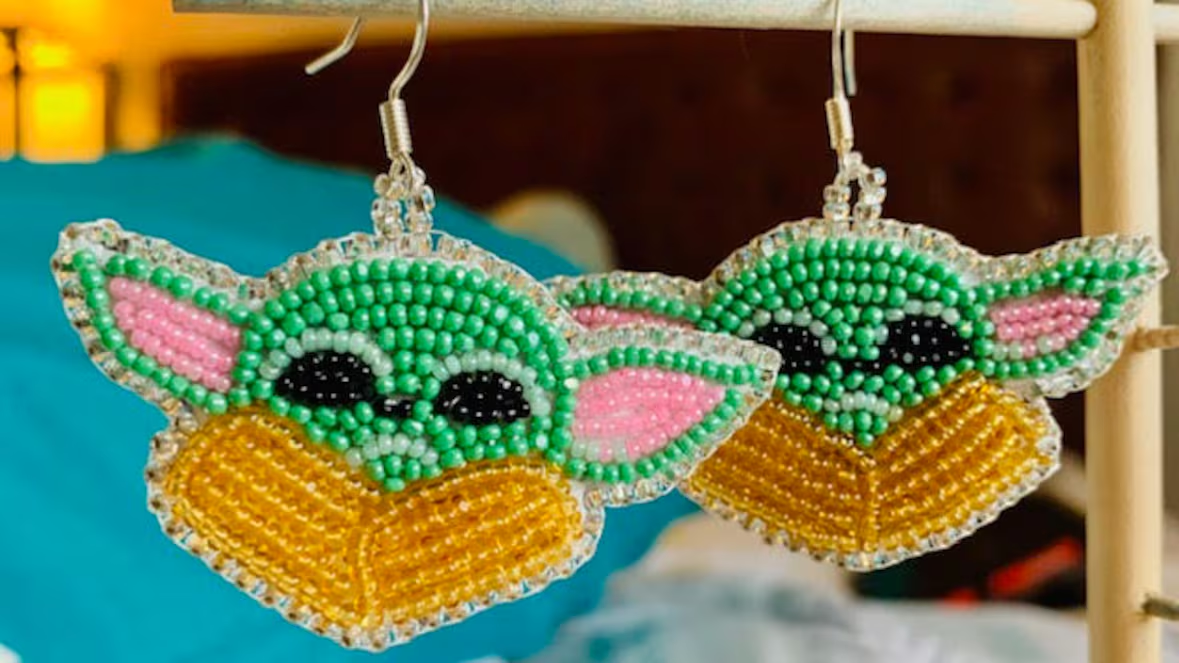
Just as Mando has had a huge impact on our art scene, Grogu has had a similarly significant impact. He is EVERYWHERE in NDN Country, from memes to beadwork. In 2019, shortly after The Mandalorian premiered, CBC interviewed several artists and meme-ists, whose work was making waves. Artist and Filmmaker, Melaw Nakhek’o (Dene) beaded Grogu into a moss basket. Artist Victoria Ransom from Akwesasne drew him in a Haudenosaunee kastowa as a tribute to her late uncle, the biggest Star Wars fan she ever knew. Comedian and everyone’s favorite auntie, Jana Schmieding (Mniconjou and Sicangu Lakota), beaded the most adorable pair of Grogu earrings. But she also summed up why Grogu has become such a vibe in NDN Country.
“I believe that our adoption of Baby Yoda actually comes from the ways which we Native people on Turtle Island really value and deeply, deeply revere not only our elders but our children,” she said.
Grogu is one of our tiny tots, our lil intergalactic nephew and grandson. We get the same amount of joy and entertainment from watching Grogu make mischief and eat his little snacks as we do from watching Tiny Tot specials at the powwows.

May 22, 2026, can’t get here fast enough! Mando and Grogu are headed to the big screen, and we’re ready to be reunited with our favorite intergalactic unc and nephew. The beadwork drops are being planned, the art is already circulating, and somewhere out there, an auntie is planning her opening-night outfit down to the beaded Grogu ear headband and ribbon skirt. We got our Mandalorian and Grogu tickets. Do you have yours?
Discover more from Red Pop! News
Subscribe to get the latest posts sent to your email.


